Sustaining the Cherokee Family by Rose Stremlau
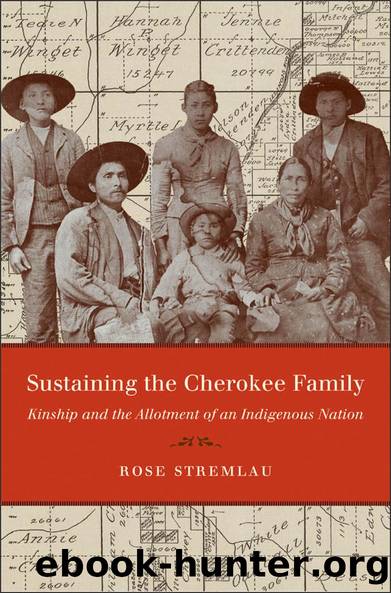
Author:Rose Stremlau [Stremlau, Rose]
Language: eng
Format: epub
Tags: History, United States, 19th Century, Social Science, Ethnic Studies, American, Native American Studies, State & Local, Southwest (AZ; NM; OK; TX)
ISBN: 9780807869109
Google: t9U2P30_ahEC
Publisher: Univ of North Carolina Press
Published: 2011-09-26T15:57:27+00:00
The Assignment of Allotments to Resistant Families
After most of their neighbors and kin had selected allotments, other Cherokees continued to oppose the policy. Many traditional Cherokees, including the members of the Keetoowah Society, had conceded to what they perceived to be inevitable and grudgingly claimed allotments. The Nighthawks, however, continued to resist U.S. intervention in the affairs of the Cherokee Nation. They withdrew from Cherokee national and territorial politics and refused to communicate with the commissioners or their staff. For this reason, as the deadline for selecting an allotment neared, the Dawes Commission arbitrarily allotted them plots of land based on information gathered from informants. Several of these Nighthawk families are included in this study: the Birds, Cheweys, Crittendens, Dogs, Hogshooters, Oakballs, Sands, Sixkillers, Suakes, and Wolfes. As the Dawes Commission dismantled the Cherokee Nation around them, the Nighthawks revitalized their religious customs and communities. As time went on, the movement generated more parallels with ancient Cherokee social organization, and ultimately, the Nighthawks created a network that unified communities under councils of elders representing the seven clans. If the customary ways of Cherokee family life had ordered the taking of allotments, family values certainly underlay the resistance of those Cherokees who refused them.
This movement had roots far deeper than the allotment era, but it was this crisis that reinvigorated traditionalists. By the late 1890s, Keetoowah headmen had expressed grave concern over the situation in the Cherokee Nation, which was overrun by non-Indian intruders and increasingly governed by the Dawes Commission and other federal officials rather than by Cherokees themselves. They concluded that threats to their sovereignty resulted from the failure of the Cherokees to follow Godâs laws for them, a primordial people whose righteous existence maintained the harmony of creation. The solution, they concluded, lay not in further political wrangling with the Dawes Commission or politicians in Washington, D.C., as many Cherokee elected officials including the principal chief proposed, but in restoring balance through their own actions and beliefs. The headmen instructed Redbird Smith to lead a committee to âget back what the Keetoowahs had lost,â and Smith, along with Wilson Girty, Anderson Gritts, Ned Bullfrog, and later Charlie Scott, set about revitalizing traditional Cherokee spirituality at the request of its practitioners.59
Over the next several years, Smith talked with and learned from the wisest elders and holy men in Indian Territory, and he synthesized their knowledge, filtered it through his understanding of Cherokee spirituality, taught it to other traditionalists, and practiced it with them. His education with Creek Sam, a Natchez holy man, focused on deepening his understanding of Natchez teachings. Although a separate tribe, Natchez people had lived among the Cherokees and Creeks since the French destroyed their nation, the last Mississippian chiefdom, in the 1730s. Despite their dislocation, Natchez families retained much of their theology, and other traditionalists looked to them for guidance. This blossoming spiritual revival among the Cherokees developed from a composite of Natchez, Cherokee, and Creek cultures, and it was emblematic of the multiethnic nature of Indian Territory.
Download
This site does not store any files on its server. We only index and link to content provided by other sites. Please contact the content providers to delete copyright contents if any and email us, we'll remove relevant links or contents immediately.
| Anthropology | Archaeology |
| Philosophy | Politics & Government |
| Social Sciences | Sociology |
| Women's Studies |
Cecilia; Or, Memoirs of an Heiress — Volume 1 by Fanny Burney(32636)
The Great Music City by Andrea Baker(32609)
Cecilia; Or, Memoirs of an Heiress — Volume 2 by Fanny Burney(32010)
Cecilia; Or, Memoirs of an Heiress — Volume 3 by Fanny Burney(31996)
We're Going to Need More Wine by Gabrielle Union(19108)
All the Missing Girls by Megan Miranda(16321)
Pimp by Iceberg Slim(14667)
For the Love of Europe by Rick Steves(14580)
Bombshells: Glamour Girls of a Lifetime by Sullivan Steve(14137)
Norse Mythology by Gaiman Neil(13458)
Talking to Strangers by Malcolm Gladwell(13440)
Fifty Shades Freed by E L James(13292)
Mindhunter: Inside the FBI's Elite Serial Crime Unit by John E. Douglas & Mark Olshaker(9420)
Crazy Rich Asians by Kevin Kwan(9346)
The Lost Art of Listening by Michael P. Nichols(7548)
Enlightenment Now: The Case for Reason, Science, Humanism, and Progress by Steven Pinker(7354)
The Four Agreements by Don Miguel Ruiz(6835)
Bad Blood by John Carreyrou(6671)
Weapons of Math Destruction by Cathy O'Neil(6369)
